Saturday, April 27, 2013

Sermon: "The Isaiah Sutra," or, Jesus' Dharma of Delight

"The Isaiah Sutra, or, Jesus' Dharma of Delight"

Preached at South Wedge Mission
Rochester, New York
Immanuel Evangelical Lutheran Church
Webster, New York
Third Sunday in Lent
3 March 2013

Day Texts: Isaiah 55.1-9
Psalm 63.1-8
1 Corinthians 10.1-13
Luke 13.1-9

~

-“Why do you spend your money for that whcih is not bread, and your labor for that whcih does not satisfy?”

-These exact words jack-hammered into my brain as the dentists’ drill descended into my teeth to seal the first of thirteen cavities.  Why, exactly, have I been pouring my spare change and my appetite into Coca-Cola, and Dr Pepper, and French Fries, and Starbucks Iced Chai - with soy mind you! - when all they will bring me is further craving, increasingly uncontrollable and distorted desire, and an empty wallet?

-Strange as it might seem, much of my spiritual nourishment this Lent as come from journeying with the Buddha.  I’m still a firm believer in the salfivific power of our Lord and Savior Jesus Christ, the Incarnation of the Trinity, etc etc.  But I like to imagine that, every time I attain an insight via the dharma into the fullness of the shalom of salvation, somewhere in the infinitude of the cosmos, the Buddha and Jesus are giving each other the ol’ high-five.

-See, Buddha, along with many Christian contemplative monastic masters like St. Anthony of the desert, St Gregory of Palamas, St John of the Cross, and so forth, taught that the first step towards living fully in God - and also, btw, cavity-free! - was to enter into a struggle for right appetite and desire.  Namely, towards sensual things.  Towards food items of various sorts.  Zen master Thich Nhat Hahn, who I had the honor of meditating with when I lived in Denver, has this to say:

Much of our suffering comes from not eating mindfully.  We have to learn ways to eat that preserve the health and well-being of our body and our spirit.  When we smoke, drink, or consume toxins, we are eating our own lungs, livers and heart.  If we have children and do these things, we are eating our chilldrens’ flesh.  Our children need us to be healthy and strong.


-Now look.  I’m no about to go imposing unneccesary or unreasonable dietary standards on anyone.  We are loved and claimed by God because of the cross of Christ, regardless of who we are, or what we eat.  Period.  End of story.

-And yet, I cannot help but be compelled by the logic of our Buddhist brothers and sisters.  The more I study their works and pray their prayers, the more I am convicted.  That spiritual practices - like Lent, for example - are given to us.  As gifts of our baptism. Not to make us miserable, or to lead us into times of mortification.  But are in fact presents.  Gifts.  Guideposts.  That lead us into a more healthy, a fresher, a more full and “shalom”-orietned way of being in the world.  A pathway to walking in the light, as He is in the light.  Not just to say “don’t be bad.”  But also, as an offering.  “Try this.  Be alive.”

-See, the prophet Isaiah doesn’t just exhort us today to avoid messing up or dying.  So much of our culture is fear-based like that.  Just drive down Ridge Road or 490 and see all the billboards promising us a better future, or, at least, a more protected one.  No, Isaiah says, quite clearly: “incline your ear and come to me; listen, so that you might live.”  It seems to me that Isaiah is proclaiming a different way to God than just “not messing up.”  Than just “ be pure and holy and a good moral example.”  Isaiah, like the Buddhists, is calling us to a different way of being.  A pro-active way of being.  A way that is not just putting off or avoiding death.  A way that is actively cultivating, seeking, and living, an abundantly life.  God’s promised new creation.  Here and now.

-I don’t know about you, but I desperately want such a new creation.  I don’t have a baker’s dozen cavities for no reason.  If you’re like me, you’ve probably experienced living life controlled - dare I say, enslaved - by some compulsion or other.  Deceived by the false promise that, somehow, fulflling this desire or want instantaneously will, miraculously, fulfill your longing, your craving, your deep-yet-deranged desire, completely.

-And maybe it doesn’t take the form of food or appetite.  Maybe its that needling in your mind that says to take on just one more 60 hour week.  Maybe it says to suspend your deepest ethical values just one more time so that the company may flourish - and with it, your vested stock options.  Maybe it begs you to give up just a little of whatever you hold dear.  Because safety, and success, and security, are worth the price of your integrity.

-And yet, as Isaiah the prophet of two millennia ago proclaims, this will not satisfy.  Because, in the end, we live this basic lie.  That somehow, we need to pay for and climb towards and even compete for a prize which has always already been given to us, free of charge.  Listen to these insane words of the prophet:

-“Ho, everyone who thirsts, come to the waters; and you that have no money, come, buy and eat! Come, buy wine and milk without money and without price.”

-See, God is calling all people to come, and simply receive.  Not to manipulate.  Not even to consume, in order to “support the economy” or increase GDP or prevent a fiscal-cliff or whatever.  God does not sequester God’s abundant gifts from God’s people.  God subverts the dynamics of sensible human economy, saying “my gifts are free and for all, and especially for those who are most needy.  For those who recognize, rich or poor, that they are nothing and cannot survive without me.”

-For someone enslaved to their compulsions and their fears - someone like me - this is very good news.  Because, see, it means that God is not primarily concerned with what we give up.  The God of Lent, the God of Jesus Christ in the wilderness, is less concerned with making us miserable through fasting.  Instead, the God who is Incarnate in Jesus Christ and who speaks by the Spirit through the prophets, also cares deeply about our health.  Our wholeness.  Our freshness.  Our being-alive.

-The God of the universe is not in this thing to make us miserable.  This God goes to the cross in Jesus Christ, shedding Godself of health, wholeness and community, taking only bitter vinegar wine as God hangs from the cross, so that we as humans might be given a new heart capable of living into the fullness, the SHALOM, the new creation, of a world where God is king.  Where we no longer have to believe the lies of compulsions that lead us to spend our time, our money, our best selves on that which does not satisfy.  A world where there truly is enough for all.  And where the promise of abundance surpasses our wildest dreams and deepest understandings.

-When I served my internship in Denver, I had the privilege of being in community with a number of alcoholics.  I was always amazed to hear their testimony converge upon a single moment of clarity.  A moment in which they recognized: “I can have a better life, starting today.”  A life where we are not merely controlled by compulsion, but drawn by desire.  A desire for the very marrow of life, transfigured by the Spirit of the Living God, to drink deeply of the goodness of creation.  See, we fast in Lent and in all times, not to deny the evils of the flesh, but to remind ourselves of just how powerful the pleasures of the present life can be.

-And its all free.  Not a result of the money we make, or the justice we do, or the good person we strive to be.  Its a free gift.  Given when we realize that we are unhealthy slaves to compulsion, and we know we need help to be something different.  Given when the dentists’ drill bores down on the first of many fillings.  Given freely, to those who trust the Word of God that indeed, we are beloved children of the Creator of the Universe, given every good and perfect gift of a loving parent, who longs that we be, not just holy, but also whole, and healthy.  Fully alive.  And so, fully capable of experiencing the joy of gratitude, thanksiging, and peace.

-Come, all who are without the money of achievement.  Whose dreams have failed.  Whose good intentions have left them bankrupt.  Come those with addictions and compulsions.  Come, all those in the universe - ALL those in the universe - who have been claimed by the cross of Christ to receive the gifts of God for the children of God.  Come, and discover the freshness, the healthiness, the wholeness, which is the free, the unshakable, the unquenchable savor of the love of God, in Christ Jesus, through the Holy Spirit.

-Amen.

Sermon: "Under the Sigil of House Jesus, or, Beyond Throne Games"


"Under the Sigil of House Jesus, or, Beyond Throne Games"

~

Preached at South Wedge Mission
Rochester, New York
Fourth Sunday of Easter
21 April 2013

Day Texts: Acts 9.36-43
Psalm 23
Revelation 7.9-17
John 10.22-30

~

-Some of you know that I kind of have this thing for Doctor Who.  But last week, I took a break from the Tardis and started reading another popular series: George R.R. Martin’s massive saga, Game of Thrones.  It’s not exactly PG, so I can’t formally recommend it to you.  You know, as a clergy person.  But as a medieval studies minor in college and someone who’s always loved castles and knights and so forth, it definitely hits the spot.

-So the grossly summarized story of GOT is that there are these seven houses, all vying for the throne recently vacated by the now dead king.  Alliances, treachery, intrigue, warfare and such ensue across the island of Westeros.)  And each of these houses has a symbol on their coat of arms, called a sigil, and a set of “family words” that both guides them and also helps describe them.  

-So, for example, the protagonists, House Stark, fight under a Direwolf and have the words “winter is coming,” since they are the tight-knit pack of rugged northerners. House Targarayen who once ruled the kingdom under the power of their dragons now go under a dragon sigil with the words “fire and blood.”  And so forth.

-Now, tonight after service, we’re meeting up at Little Venice to continue our conversations together about who we are as a community.  One thing we’ve discussed recently is potentially changing our name.  And as a visual person, I keep thinking that along with a name, there should be some kind of a sigil (nowadays they might be called icons or logos).  

-Left completely up to me, I’d choose a lion.  Brave, noble, fierce, a leader.  Jesus was called Lion of Judah. And one of our community heroes, Frederick Douglass, was known as the black lion.  

-But the lion would not suffice on its own.  First off, its the symbol of House Lannister, the wealthy, proud, conniving incestuous villains of GOT.  But even more importantly, in the book of Revelation where our reading is from tonight, the one described as a lion is not Jesus.  In fact, dragons, wolves, and lions are all used in connotation with Satan, the antichrist, and the Roman Empire.    

-We do get an animal, presented sigil-like in the reading.  It stands at the head of a vast army.  But not of conquering warriors bearing swords.  It stands, slaughtered, before a host of martyrs - innocents slaughtered by the Empire, washed white in the blood of their leader.  And their leader is a crucified lamb.

-A lamb.  Not even a full sheep.  Hardly something that strikes fear into our enemies, right?  In fact, when I think of sheep, I think immediately of growing up in Fairport.  Yes, it is a suburb.  But right smack in the middle of several developing areas is this massive old farm, filled with sheep.  And its affectionately known to all as “the stinky farm.”  Because it stinks.  Because it is full of sheep. 

-Along with reading epics filled with sex and violence, I’ve also been enamored of my daughter’s kids‘ Bible, the Jesus Storybook Bible.  Perfect compliment, right?  Well, the author, Sally Lloyd-Jones, also wrote a kids‘ devotional, called Thoughts to Make Your Heart Sing.  And here’s what she writes about sheep:

-What animal does the Bible say - four hundred times! - that people are most like?

Oh dear. It’s sheep.

Sheep aren’t clever at all.  They’re foolish.  For instance, sometimes they just topple over and can’t get themselves back up again. They just lie there!  And they’re constantly falling off cliffs.  Or going to unsafe places and getting stuck.  Or eating poisonous things.  Or getting hurt.  Or running off and getting lost.  Or not finding their way home again - even if their fold is in plain sight!

-Oh dear indeed.  The sigil for House Jesus is a sheep.  A stinking, stupid, let’s you steal the clothes off their back, sheep.  Not a strong adult ram with horns.  Not even the one that won the county faire.  It’s a lamb.  A crucified lamb.  A dead lamb.

-Not exactly what most of us often hope for in times like this, no?  Times when we read in every other post and tweet about people disbelief about “how vulnerable America is,” “how messed up humanity is,” where bombs terrorize finish lines and fertilizer plants explode during routine operations.  If you’re human, I’m guessing that in the midst of such a shit storm, like me, you’re looking for some comfort.  For something that promises safety.  That promises security.  Something powerful.  

-We want the direwolf, or the dragon, or the lion.  Or the sigil of stars and the stripes.  And the family words, “let freedom ring.”  And a shepherd who will “hunt these terrorists down.”  In the confusion of emotions, we follow after a media that somehow magically develops psychic powers to narrate not only every second of events, but even, psychically, what the fugitives must be thinking before they even know it themselves.  Because knowledge is power too.  It’s security.  Gives us a sense that we are most definitely not that crazy Muslim dude.  Somehow, the insane immediacy of information allows us to put a safe distance between us and the terror.

-See, we want our kings, and our kingdoms, and our sigils, and our words, to give us security.  To keep us from suffering.  Or to make someone else pay so we don’t have to.   We want them to lead us to green pastures, and feed us with grass that sustains.  

-And what makes us foolish as sheep is not so much that we are loyal to our country, or that we want to work for justice, or even that we are afraid of being vulnerable.  What makes us foolish as sheep is that we follow shepherds who promise what they cannot deliver.  They promise peace, and prosperity, and progress, and protection. But millennia of human history says otherwise.  They cannot give us the crown, or the kingdom, or salvation.  They may feed us and lead us.  But not through the valley of the shadow.  Not to a feast in the presence of our enemies.  It is, after all, their games of thrones that have helped make those valleys and enemies.  

-But thank God, this is not the sigil or the king revealed in scripture today.    

-Our house words are different.  As members of Christ’s body the church our house words are “salvation belongs to our God and to the lamb.”  Our house anthem is not “bombs bursting in air,” but “though I walk through the valley of the shadow of death, I shall fear no evil.”  Though I walk through the valley of the shadow.  In the presence of mine enemies.  Not IF I face suffering, and vulnerability, and death.  But when. 

-It is the sigil of a shepherd who willingly becomes a sheep.  Becomes like us, in our weakness and stupidity and lostness, and is sheered of dignity and power and would rather be slain than lift a finger of violence or vengeance.   And descends into the valley of the shadows of death and hell.  And then this lamb rises from the dead.  And washes the fallen victims of violence in his own blood.  And promises to wipe away every tear.

-And see, that’s ultimately the meaning of our sigil.  It is a promise.  Of true provision.  And of true hope.  Because this lamb, this Jesus, is not an ideal or a program that must be defended with violence, or explained by social media, or even be believed to be true.  This lamb, the one slain by the Romans, was also the man, Jesus Christ.  God Incarnate.  The only one who can keep his promises.  Who can feed us, his enemies, with a feast of his own body and blood.  The one, the only one, who makes broken things come undone.  Who alone has power to deliver on His promises.

-This lamb, this king, this God, is not toppled by the blasts of bombs.  He stands at their epicenter.  He does not run from the valley of the shadow.  He leads his followers into it.  He does not avoid death.  He faces it, experiences it, becomes vulnerable to it.  And then crushes and defeats it by love and peace alone.  

-Which means that we are never NOT vulnerable.  We are never NOT unsafe.  Because following this lamb will mean following him into the war of the lamb, the war of peace and love and reconciliation (and besides, an armed sheep is kind of an absurdity, right?)  

-See, the sigil of our King is not one that promises security at all.  There are many who lament that our nation feel more vulnerable than ever. The followers of the Lamb know that we have always already been called to be vulnerable because of who our Shepherd is,  Christ leads us through the valley of the shadow, not because suffering is good but to bring the good of companionship and love to all who suffer. Our vocation is to follow
and do likewise.

-We are called to follow him into the valleys of the shadow.  Places in the world where, for women and children denied education and rights, every single trip top school or the well is a Boston Marathon of terror.  Into the dark secrets and difficult struggles of others where there is no answer, but where we are called to walk together anyway, receiving and protecting one another’s vulnerability.  Not if we walk through the shadowlands.  But when.  

-And this God will provision us.  Feed us.  Care for us.  Promises to give us what we will need.  He gives us liberation from effectiveness, so we might be free for faithfulness. Challenges us to let go of everything else.  And he arms us.  Not with swords, guns, bombs or information.  But with God’s promises already coming true in the resurrection light of the new creation.  The Spirit of hope.  The ways of peace.  And lives of love.  

-We are called to lay down all other weapons and forsake all other shepherds.  And to march boldly into the shadowlands.  To the tables of enemies.  And to the place where the hope that all tears be wiped away will come true.  Under the sigil and the words and the promises of the Lamb.  Who promises, not that we will be safe.  But that he is for us.  And that he will never leave or forsake us.

-Oh dear.  Amen.  

Wednesday, February 27, 2013

Sermon: "Shut Up and Listen, or, a Sermon for Frederick Douglass Sunday"


"Shut Up and Listen, or, A Sermon for Frederick Douglass Sunday"

Preached at: South Wedge Mission
Rochester, New York
Frederick Douglass Sunday/Second Sunday in Lent
24 February 2013

Colgate Rochester Crozier Divinity School
Rochester, New York
CRCDS Social Justice Fellowship Chapel Service
26 February 2013

Day Texts: Genesis 15.1-12, 17-18
Psalm 27
Philippians 3.17-4.1
Luke 13.31-35

~
Frederick Douglass died on February 20th, 1895.  He was a resident of Hamilton St in the South Wedge Neighborhood of Rochester, New York.  We chose to honor him on this Sunday.  The Episcopal Church offers this collect for his commemoration:

SWM's Frederick Douglass open space station,
where quotes from his life were written on links
of chain.  We broke them off, one by one, and
wrote them on prayer flags, which will become part
of our worship space, and our hope for our community.
Almighty God, 
whose truth makes us free: 
We bless your Name 
for the witness of Frederick Douglass, 
whose impassioned and reasonable speech 
moved the hearts of a president and a people 
to a deeper obedience to Christ. 
Strengthen us also 
to be outspoken 
on behalf of those in captivity and tribulation, 
continuing in the Word of Jesus Christ our Liberator; 
who with you and the Holy Spirit 
dwells in glory everlasting. 
Amen.

~

-Grace, mercy and peace are yours from the Triune God.  Amen.-The Pharisees, as you may know, are basically Jesus main antagonists throughout the Gospels.  The Daleks to his Doctor Who if you will.  And yet, for some strange reason, today we find them actually warning Jesus about King Herod.  Who is not such a good guy. 

-Now maybe they're first-call Pharisees, or seminarian Pharisees, and so, have been confused by an overly political vision of religion.  Or maybe the Pharisees are just trying to scare Jesus off.  Though if I were them, talking to my enemy, I'd probably say, "YES! GO to Jerusalem, it's all good there!  No death or dying for you!  It's NICE in Herod's palace wink wink!"  Or maybe they’re delivering a message for the tyrant.  Making Jesus an offer he can’t refuse.  Church authorities being corrupted by political power.  Never happens in our time, right?

-But Jesus fires back with a message of his own.  “Go and tell that fox” – in the Greek, its actually feminine, almost like Jesus is undermining the psuedo-masculinity of the threatening tyrant...so – “go and tell that vixen of a king: listen.” Listen.  Cease your posturing.  Quit hiding behind your minions, and your privilege, and your power.  And check it.  “I am casting out demons and rocking the healing circuit.  And I’m not going to stop until I hit Jerusalem.”  Listen Herod.  Something else is going on.  I’m the Jesus.  I’m coming.  You're on the wrong side of the cross.  And there’s not much you can do stop me. 

-And yet, Jesus’ prophetic action, the beginning of his response of speaking truth to power, is to tell them, essentially, to shut up and listen.  And he makes this demand, in order to point the powerful to the true miraculous power happening, not in palaces and temples, but down below, on the ground, amidst the powerless and forgotten.  Where demons are being cast out.  Where sickness is being eradicated.  Where God is happening.  Among those with whom Jesus is in solidarity.  Those for whom the prophetic Jesus is speaking.

-And that’s a hard place to go.  To have to listen.  To release the feeling of control that comes in words, and privilege, and power.  Because it first of all means an unmasking of ourselves.  It’s one thing to reveal that the emperor has no clothes when it is an emperor like Herod or Caesar.  But I wonder if there’s not a dash of Herod in each of us too.  Even in our best moments, that wants so badly to dictate the terms of engagement.  Trying to keep Jesus from coming to Jerusalem.  Where he might actually confront us.  Change us.  Force us to discover all that we do not know and cannot be.  Order us to silence.  Or to suffering. 

-Being cast down from your throne is not fun.  When I was in seminary at Duke Divinity, I was elected co-president of the Divinity Student Council.  As a leader of the student body, I had all these ideas and ideals about how to cultivate community, and work for reconciliation among a student body grappling with the open wounds of race and gender discrimination.  I had read all the right books, had all the right intentions.  Now, to prophetic action!

-And so, I gave speeches, and rolled out plans.  And continued to try to promote programs and initiatives throughout the year.  But nothing seemed to change.  Towards the end of my term, I found myself in the Women’s Center, talking with my friend Brandy, who was also the head of Sacred Worth, the GLBTQ alliance.  I was lamenting to her about how frustrating the year had been.  “I feel like people think I’m a privileged asshole,” I concluded.  And she said, “yes Matthew, they kind of do.” 

-Ouch.  Why, I wondered?  Wasn’t I trying to help the marginalized and all that?  And she said, “I know you care, and you have great ideas.  But caring’s not enough.  You never came to our meetings.  You never showed up to be with us. You never really took the time to listen.”

-Double ouch.  But also thank God.  Thank God that Brandy played the Jesus to my Herod.  Drove me from a place of playing at being a prophet, to a place of sitting at the feet to learn from those whose suffering was already prophetic.  Because she was willing to speak a hard truth to me with love and a desire for my transformation, Brandy opened me up to a whole world.  Of hearing the stories of African American students, and gay students, and women seminarians, who had fallen between the cracks of the blind spots of my own need to “be the change.” 

-And hearing this was hard.  Not only because I had to face the fact that I was more privileged than prophetic.  But also because it forced me, who as you may have noticed loves to talk, to listen.  To stop talking about the injustice.  And instead to experience it.  To be exposed to and by it.  To suffer it.  See, in hearing Brandy’s pain, I began to feel pain too.  Pain for her, and the suffering she had undergone at the hands of good intentions like mine.  Pain that led me, not only to listening, but to lament.

-And see, that’s the even more powerful bit to me about Jesus’ way of being prophetic.  Jesus is not afraid to cry out.  Not merely in heroic rebellion against the powers and principalities.  But also to take on himself the suffering of the community he loves.  “Jerusalem, Jerusalem,” he cries out.  “You who are so bound to endless cycles of power, and privilege, and willful blindness and violence! How I long to gather your children together as a hen gathers her brood under her wing!”  Standing at the very heart of the rift between brothers and the rupture of injustice undergirding the powerful, Jesus lets his rage becoming something more.  He weeps.  He laments.

-See, that’s the other thing that can happen if we listen.  We might not just have to change our minds.  We might end up bearing the terrible pain and the heartbreak of the stories of others.  I know for me, it’s much easier to look at a moving photograph, or read an account of human suffering, than to have to look into the eyes of someone and receive their scars.  Ideals and good intentions feel safer. 

-But Jesus is the one who, even though he is God Incarnate, willingly abandons the safety of privilege and power.  Jesus listens.  And Jesus weeps.  And Jesus suffers with.  Which means that God listens.  And God weeps.  And God suffers with too.  And such suffering with, such compassion, such solidarity, leads this God to take on the suffering, and the sin, and the failures of power, and the schemes of humanity, and to carry them to Jerusalem. To Calvary.  Where the ultimate act of prophecy can take place.  The non-violent overthrowing of the violent.  By the solidarity of the cross.

-I think it’s quite fitting that, having risked listening to and weeping with the poor, having allowed himself not to get even, but to be moved with compassion, Jesus here also uses a very powerful feminine image of God.  It’s almost as if, in his listening compassion, Jesus purposely seeks to expand the picture of God we have.  From the (em)masculated fox, Herod.  To the fierce and powerful love of the Mother hen.  That’s the power of listening.  And of lament.  They change the game.  Where hens are stronger than foxes.  And prophetic compassion trumps the violence of privilege.  And where our tiny visions of a God-like-us might give way to a conceptions we never imagined.  God as woman.  God as black.  God as gay.  God as not-quite-like-us.  

-Crazy what happens when you listen.  Today is Frederick Douglass Sunday here at the Mission, and I think on the great South Wedge Abolitionist, because his journey of justice also began with a listening.  In his groundbreaking autobiography, Douglass recalls his first encounters, while a slave, with the “wild songs” of the slaves, which “revealed at once “the highest joy and the deepest sadness.”  He writes:

Bust of Frederick Douglass
from outside the chapel at CRCDS
The hearing of those wild notes always depressed my spirit, and filled me with ineffable sadness.  I have frequently found myself in tears while hearing them…to those songs I trace my first glimmering conception of the dehumanizing character of slavery.  Those songs follow me, to deepen my heart of slavery, and quicken my sympathies for my brethren in bonds.

-Douglass’ deep compassionate listening to the pain of his people led him into a long, suffering battle, not only for the slaves, but also, for others whose humanity was being violated.  In 1848, just down the Erie Canal at the Seneca Falls Convention, he was the sole African American man to attend the convention to pass a resolution demanding women’s’ suffrage.  And when most of the other men came out opposed, Douglass alone stood fast, and put the powers of his mighty oratory into the service of those to whom he had deeply listened, drawing on the prophetic energy of compassionate lament, undoubtedly forged in the fires of the suffering of those wild slave songs, enough were moved to pass the resolution.

-Crazy things can happen when we listen.  The suffering of the world will break our hearts.  Our souls may just end up crying out under the weight of a compassion we’d rather run from.  We might even find ourselves following Jesus on that lonely prophet’s journey to Jerusalem, and to the prophet’s fate upon Calvary’s hill.  But that is the way that God Incarnate has set forth for us.  Listening.  Letting go.  Lamentation.  And, if we are so blessed, a love that is stronger than hate, more powerful than privilege, and impossible to deny.

-That is my prayer for myself this day.  And my prayer for this family of God at the South Wedge Mission, and at CRCDS.  And my prayer for each of us.  That we would listen.  Let go.  Lament.  And so love, truly, deeply, richly, prophetically.  

-In the name of our Mother God, the gathering hen, the great listener. Amen.


Friday, February 22, 2013

Sermon: "The Spring Revolution: A Manifesto, or, How the Grinch Stole Lent"


"The Spring Revolution: A Manifesto, or, How the Grinch Stole Lent"

Preached at South Wedge Mission
Rochester, New York
First Sunday in Lent
17 February 2013

Day Texts: Deuteronomy 26.1-11
Psalm 91.1-2, 9-16
Romans 10.8-13
Luke 4.1-13


~
I continue to engage in an "experiment" of my own in my preaching.  Namely, trying on an extemporaneous style.  This adapted from the original MSS and the audio, which wasn't clean enough to post.  Thanks for having solidarity with me in this!  
~

I always enjoyed Lent growing up.  I loved the minor key German chorales that sang of sacred heads now wounded and going to Dark Gethsemane.  Loved actually living the stories of Holy Week, as we journeyed liturgically with Jesus from the triumph of Palm Sunday to the heartbreak of Good Friday.  As far as ways to reflect on such easy topics as, you know, sin, suffering, mortality, failure and death, there’s definitely worse ways to go about it.

But this year, its feeling to me like the Grinch has stolen Lent.  Because for once in my teutonic existence, I’m not actually really feeling the whole existential angst thing.  Maybe it comes from returning home to a city where its cloudy and grey pretty much every day.  Or maybe it just feels like there’s enough suffering in the world already.  

Or maybe, Lent’s not all it was originally cracked up to be.  Because back in the day, in the early early church, before the Dark Ages brought the dark to the ages, the 40 days leading up to Easter wasn’t primarily focused on guilt and sin.  Rather, it was focused on identity.  Namely, our identity in Christ.  And initiation into a new community, a new family, as a new creation.

See, this time marked the final home stretch for folks seeking baptism and inclusion into the people of Jesus.  These catechumens, as they were called, did go through some fasting, and penance, and public scrutinies and even exorcisms.  But these were in the service of deepening their experience of the mysteries of faith, a way of building anticipation for the moment, at the Easter Vigil, when, having seen their old self buried with Jesus, they would enter naked into the baptismal bath, be immersed in the waters, and arise to be anointed with oil.  Like Jesus at his baptism.  To be called, like Jesus, beloved sons and daughters of God.  

It makes me wonder about how I’ve always read our Gospel lesson for today.  Because I think I’ve always read it through the Grinch’s lens of a miserable Lent.  And so always thought, “man, Jesus is baptized and told God loves him, and then is sent to starve in the sand for 40 days?  What a raw deal.  That’s tough love.”  

But I wonder: perhaps Jesus might have enjoyed his time of sojourn in the desert.  Now granted, the whole fasting thing is not exactly cake.  But maybe Jesus spent his time communing.  Living into his newly declared identity of beloved child.  Maybe he took the time to bask in the beauty of stars at night in a cloudless desert sky.  Discovered and explored hidden caverns.  Drank deeply of the cool of the shade.  Living into being a community, a Trinity, with the Father and Spirit, and so, growing deeper into his truest identity and self.  A sureness of intimacy with God that no voice of temptation could ever shake.

And see, I think this might be what St. Luke’s after here in his telling of the story.  Because Luke’s is the only Gospel that says that Jesus was led into the desert WHERE he was tempted.  The others say “TO be tempted,” as if that were the point.  But for Luke, the temptation is secondary.  Its the being led - by the Spirit - that is central.  

And see, if Jesus’ desert sojourn was really about knowing himself more deeply as God’s beloved child - and if the purpose of the early church’s practice of Lent, and even our Lent, is about knowing ourselves as God’s beloved children - then its no wonder to me that Satan assumes the mantle of Grinch, and tries to disrupt Jesus from the path.  Trying to make this time more about the lack of food, or the lack of power, or the lack of security.  Taking the focus off of God and identity, and onto practices and failures, lack and unworthiness.  Questioning again and again, “if you really ARE God’s Son...” while dangling the carrot of achievement and success in front of the one seeking grounding, not in the doing of things, but in the being of someone.  God’s someone.

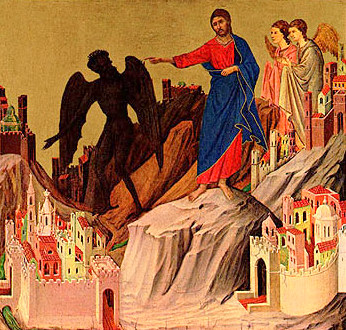
Now, regardless of what you think about El Diablo - whether you think he’s a little red guy with hooves or the spiritual equivalent of a monster truck rally - this Lenten temptation is very much real.  The Grinch that tries to steal Lent from us, again and again, is the nagging, whispering, satanic voice trying to steal the gift of knowledge of God’s love for us by focusing us on our lack of love for ourselves.  The goal is a disrupted communion.  The goal is a heart ten sizes too small.

I’m not going to write the rest of this message in Dr. Seuss rhyme.  Lucky you.  But what I would like to do is try on an old preacher trick.  The infamous three-point sermon.  I’d like to explore three different ways we could try to view and so live Lent as a time of internalizing, exploring, and deepening our identity in Christ.  A time of taking the words “you are God’s beloved child” and letting them sink from our heads into our hearts.  A re-orienting time of initiation, or re-initiation, into the desert adventure of companionship with God.  

So here goes.  A draft of a manifesto for a Spring Revolution.  Because Lent means spring.  And God’s after what Dorothy Day called a revolution of the heart.

First, off, what if we viewed Lent as an experiment?  Much to my mother’s chagrin, I’ve been learning a lot from the Buddha recently.  And one of his main teachings is that truth is something that we do.  That we learn.  Not just think.  What if Jesus went out into that desert, not so much to contemplate the knowledge that he was God’s beloved, as much as to live it out?  To experience it?  To practice it?

It reminds me of my dear friend Marcus from Denver.  Marcus was part of a subculture known as “crust punk.”  Basically, a bunch of kids who dropped out of high school and ride the rails, or hitch-hike, all across the country, learning how to make things and survive and explore.  Modern day Beats, scruffy Jack Kerouacs.  Magnificent beards too!

Well, Marcus also happens to be a Christian.  And he and a bunch of his friends travelled, specifically to live into their faith in God’s promises.  To try out what it might be like to have nothing except God, and be utterly dependent upon God’s providence and promises for survival.  Their life on the road was a grand experiment.  And oh the stories he had to tell!

What if life with God in Lent was more like On the Road? A time to set out on a journey, to try things, to live the Beat life...which, at its root, means “beatified?”  If we stopped trying to achieve or manufacture some sort of identity, and instead, clothed ourselves in nothing but our God-given identity, and then, see what happens?  

Might it look like a 40 day trip in the desert, putting on the practice of prayer and fasting?  Perhaps.  Or maybe it looks like trying to fast just once.  This week.  Seeing what its like.  Taking a baby step.  A first endeavor.  And then, reflecting.  Conversating.  And then, figuring out a next step.  Life as an ongoing process of discover, experimenting with what being God’s child means right now.  Not as we imagine we’re meant to be.  But as God tells us we are.  Right now.

Takes away some of the pressure, right?  It can be more of a time of wonder, and less one of fear.  In the Gospel, Satan tries to disrupt Jesus’ experiment, praying on his hunger, offering him an easy closure in the form of a quick fix.  Just turn the stones to bread, and its all over.  But Jesus resists.  Like Marcus, decides to live by the Word of God alone.  

What a life of freedom it would be to live our spirituality as an experiment.  Lent’s a great time to try out the little experiments (and the grand ones too) that you’ve always wondered about.  Test it.  Try new things.  Make mistakes.  Fail!  And then explore a different angle.  What would Lent be like if you knew you couldn’t fail?  Because you already know who you are.  Now its just a matter of living into it!  

I wonder if we might live differently.  Able to engage in a second way of looking at Lent - that of resistance.  Satan quite clearly tempts Jesus with the promise of power.  In exchange for idolatry.  Worship me, and you’ll have complete control, whispers the Grinch.  And Jesus, being the Son of God, has all the power in the world to zap him out of existence.  And yet, Jesus does not.  

Jesus knows who he is.  And whose he is.  And whose he is not.  And because he is secure in himself, he does not need to use violence or force.  But he does resist.  Throws idolatry and false worship and false promises into the abyss.  Turns down the offer of power, and also the promise of miraculous attention, just as he will, years later, when he is being raised upon a cross.  Because God, in God’s love for us, would rather forgive than raise a finger of force.

But he does resist.  Gandhi called his great nonviolence work “experiments in truth.”  Rebellion against the empty lies of the devil and the empty promises of violence, this is part and partial of our true identity.  Perhaps it will mean giving up things the world offers, refusing to believe their empty promises, just as catechumens are called on to renounce “the devil and all his empty promises.”  It might mean re-examining our idolatrous complicity with the powers and principalities of this earth.  It might mean suffering, and losing control. (Hence why we’re participating in the Season of Non-Violence! See link here for more)

But as children of God, experimenting in truth and love, freed from failure, and made alive by the Spirit, we are given the time to be faithful.  We are given the promise of love to give us hope.  And we are armed with weapons of love in the war of the Lamb, which is to smash all lies, disbelieve all falsehoods, doubt our doubts, and to live our callings.  It will bring us into conflict with the world.  And it is a rebellion worth undertaking.  

And we do not engage it alone.  Because Lent is also a time of solidarity.  We do not experiment alone, but as part of a great workshop, a lively laboratory, of colleagues, dead and living and yet to come.  And resisting and rebelling against the death-dealing idolatries of the world will mean coming into relationship with those who have been oppressed by them.  It will mean walking with the poor, the marginalized, the betrayed, the beaten, and yes, even the damned.  It will lead us into the wilds of human suffering.  And into the ecstasies of human community.

And it will lead us to one another.  In this community, here.  We will journey together, and we will discover together, and hold one another, and guide one another to oases.  And we’ll also fail one another.  We are companions with one another, and fellow travelers with Jesus.  We will face dangers, just as Satan tempted Jesus to leap from the roof of the temple.  Jesus was promised angelic companions, but Jesus knew that he already walked in the fellowship of the Spirit.  We are sometimes tempted to go it alone.  But Jesus has left us, not only with the Spirit, but with each other.  

This is a time when we will delight in discovering together the wilderness.  Sharing observations.  Supporting one another’s experiments.  Carrying each other in the resistance.  Remembering, like the ancient Israelites, who we were, as slaves, and so knowing we are meant to be, as the liberated, and the being-liberated, and the liberating.  And, helping each other remain capable of being surprised, able to wonder, able to adventure.  Its a time to grow deeper together, and to fail forward.  Together.  All of us.    

And of course, this manifesto is not complete.  What new ways of living Lent, of being children of God, can you devise?  I look forward to exploring them together. I look forward to receiving them from you, here, in this flourishing, beautiful oasis in the midst of the desert of the world.

And best of all, as John Wesley once said, best of all, God is with us.  If Lent, if Christianity, is just about achieving, if its just about misery, if its just about struggle, then by all means, let the Grinch have it.  But maybe, just maybe, we can steal it back.  By refusing to live any other truth about ourselves than the truth declared by God and sealed by the blood of the cross.  The truth that we are God’s children.  That we are claimed and beloved of God.  That we belong to one another.  That we are free to live fully and explore broadly and fail miserably.  And that we are never alone.  We never walk alone.

So.  Welcome to the Spring Revolution.  Welcome to Lent.  Welcome to life.  Welcome to who you really are.  Amen.